Pages

Showing posts with label 18th Century. Show all posts

Tuesday, 5 February 2019

Sir John Barrow's Cottage, Ulverston | Snapshot Series

Sitting on the junction of two Ulverston roads stands a small building once home to Sir John Barrow.


Sir John Barrow, as mentioned in an early post about Hoad Monument, was born in Ulverston during the 18th Century and went on to be a founding member of the Royal Geographical Society.

This small cottage at Dragley Beck was where he was born on 19th June 1764.

It would have looked a little different back then, for a start the roof would have likely been made from thatch and there would have been a garden wall sweeping round the front of the building.

At the time Dragley Beck was also a small village in the parish of Ulverston. It certainly wouldn't have been as busy as it is today. Of course as time moved on the village was fully enveloped by the growing town.

John grew up in the area and went to school at Town Bank Grammar School in Ulverston. John left at the age of 13 though to set up a Sunday School for the poor, before moving to Liverpool where he found work at an iron foundry.

This building is a wonderful remnant of the past and it is excellent that it is still standing today.


The building is now looked after by Greenlane Archaeology who open it at various times throughout the year. You can find out more on their website here.


The Snapshot Series is a series of short posts on singular locations, features or artefacts found in the Furness area. Not large enough to warrant a long blog post we will explore these sites in snapshots!


Tuesday, 17 January 2017

The Pinfold, Dalton | Snapshot Series

In the shadow of St. Mary’s Church, sitting on Goose Green in Dalton-in-Furness, is a peculiar little feature known as the pinfold.


The pinfold is a circular enclosure built out of local limestone. It was built sometime in the late 18th – early 19th Century. It’s hard to pinpoint an exact date of construction but it does feature on the Merryweather’s town plan of Dalton in 1825. It is thought though that the structure may well have been present in the 1700s.

In its day this cute little feature would have been filled with any animals found roaming the streets of Dalton. Any stray sheep or cattle would be locked within until the owners came to retrieve them. You can really imagine how it must have been, the grassy patch of land between the walls brought to life with animals roaming, chomping on the grass.


The Snapshot Series is a series of short posts on singular locations, features or artefacts found in the Furness area. Not large enough to warrant a long blog post we will explore these sites in snapshots!


Tuesday, 8 November 2016

Making Iron from Ore, Newland Furnace

On the outskirts of Ulverston there is a small village by the name of Newland, it is a quaint little place with some lovely cottages surrounded by fields, a typical country village. But at the heart of the village is something with a much more industrial past, Newland Furnace!

This remnant of the areas industrial past was built in 1747 as a charcoal fired and water powered iron furnace. Charcoal was used as the fuel to create the fire and heat needed to melt the iron ore while the water would power a large water wheel which operated large bellows. These bellows would be brought up to let air into them then pushed down to release the air through a small exit into the bottom of the furnace. This would feed the fire with oxegen to get it hotter and hotter.

During its working life the furnace was producing 28 tonnes of iron each week, an incredible amount, and to produce that amount it required an even greater amount of charcoal. 56 tonnes to be precise. This meant they required a large barn to store the charcoal and you can see this in the picture to the right. This is always the interesting thing about these industrial sites, they often supported other industries in the area. Here they would have been a life line for the local charcoal burning industry, such large quantities being required each week would have provided healthy work for the men in the woods with their burns. It does make you wonder how fruitful that charcoal industry was once these types of furnace closed.

Newland was owned by Richard Ford but had been bought on his behalf by his sister Agnes Bordley. In 1735 Ford had entered an agreement with a Thomas Rigg who owned and ran Nibthwaite furnace alongside Ford. The agreement was that neither could set up a new furnace within 10 miles of Nibthwaite, unfortunately Newland was within 10 miles. Due to this Ford had his sister purchase the site on his behalf, this meant he had not broken the agreement and could open his own furnace, which he did, and the rest is history!

The furnace was once one of eight of its kind in this area smelting iron using charcoal. Something which in later years became obsolite with the rapid use of coke, which produced a much higher heat at quicker rates. This meant that many charcoal firing furnaces either shut down or converted to coke. Newland Furnace however managed to keep operating with charcoal for almost a century after many others had converted or closed. Sadly though in 1891 Newland shut for good and became a relic of a past age of charcoal iron smelting.

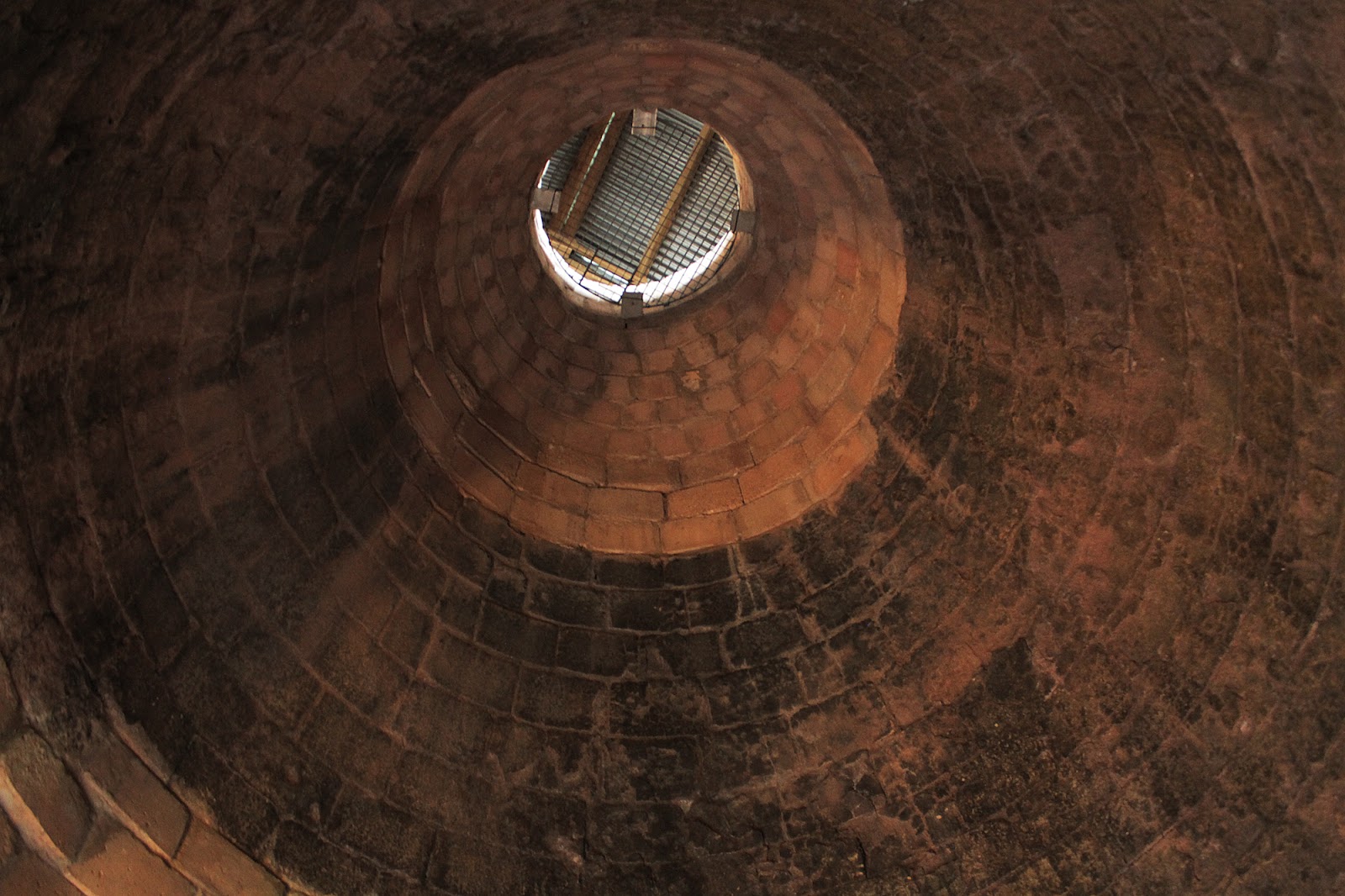
By the mid 1980s much of the site was un-used and quite a state when a selection of people were brought in to make the building safe. Many of these people took great interest in the site and decided, in 1998, to set up a trust to renovate the building, this was the start of the Newland Furnace Trust. Since then they have rebuilt the top of the furnace chamber, excavated the interior of the blowing chamber, re-boarded the floor of the large top room and generally looked after and renovated the site. In the image here you can see the inside of the furnace chamber and the clear line where the new bricks have been added ontop of the old ones. The old being blackened from the many years of charcoal fires raging around them. The work the group have done has been amazing and shows a real love for the furnace and will stand it in good stead to last well into the future.

The site is accessible from the outside and there are a few information boards to help you better under stand the building. On certain occasions the furnace does open on days like the Heritage Open Days for everyone to see inside, speak to members of the trust and learn more about this facinating building, so do keep an eye out!


Do come back on the 22nd when, instead of taking a look at one site, we will be looking at the whole of the Furness area in the Viking Age!

Tuesday, 26 November 2013

Water Reflecting an Industrial Past, Ulverston Canal

Stretching out from Ulverston town to meet with the sea at, the appropriately named, Canal Foot is Ulverston Canal. An 18th Century built canal made for the import and export of goods to and from Ulverston.

Today the canal has a number of footpaths leading to and along it for anyone to use. There is a footpath that runs along the whole canal and is a lovely walk to take. Walking along this path, if you look closely, you can see some interesting reminders of the once working canal.

The canal was once the shortest, deepest and broadest in Britain and was first started in 1793 with Thomas Sunderland cutting the first sod on June 1st. The company Pinkerton and Murray had won the contract to dig the Canal and basins. They earned 3 1/2d per cubic yard but a lack of funds ended in them being unable to complete the contract. A Mr H. Baird took over to complete the canal construction, which was now lagging behind. Originally intended to open around 1794 the Canal eventually opened over two years late in 1796. Locals gathered around the locks at Canal Foot to witness The Sally be the first vessel to enter the Canal. A further three vessels entered after including The Content which was pulled with rope along the Canal by the crowds. The Content managed to overtake The Sally and was the first to reach the top basin of the Canal at Ulverston!

The Canal was built for the import of coal, cotton, timber, spirits and sugar to Ulverston and the surrounding area. It was also used to export charcoal, slate and linen to the rest of the country. With the newly built Canal many industries sprang up along it's edge including an iron founder, a timber yard and appropriately a sail maker and a boat builder. The Canal opened up new possibilities for industry and trade providing a new platform to export across the country and even beyond.

Along the Canals edge you can come across interesting remnants of the past. The footpath on which you walk is the 'towpath' of the Canal, which, as its name suggests, would have been used to tow sail-less boats along the canal. Humans or horses could have used this path to tow the boats. Along the towpath there are small metal capstans, pictured to the left, which boats could be tethered to, to prevent them drifting off in the water. There will no doubt be many of these hidden amongst the undergrowth along the canal so keep an eye out for them. Running next to the towpath is the back drain, this would have been constructed to drain any excess water from the canal to keep it at a set level. It would have been important to keep the water level at a set point to avoid flooding at the many industrial sites springing up right next to the canal.

Trade hit its peak on the canal in 1846 with 944 vessels entering it that year. With the discovery of iron ore in Furness the need of a railway to transport the ore to Barrow became evident. It was in May 1844 that a Furness Railway Bill was passed and a railway opened in 1846. By 1854 the railway had reached Ulverston and with this came the decline of the Canal. In 1857 a new section of line opened that cut right across the Canal. As pictured to the right a viaduct, to take the new track, was built across the Canal, this prevented tall ships from reaching the top basin. Iron became cheaper to transport by rail than by boat, this along with the viaduct's construction saw the end of the Canals dominance in industrial transport. Eventually, in 1949, the Canal was empty of boats and the lock gates at Canal Foot were sealed with concrete never to be opened again. The lock gates still remain today, if in a state of disrepair, as a lasting reminder of the Canals glory days in the 18th and 19th century.

The Nahula sitting as the last boat on Ulverston Canal.
She was the last vessel to ever sail through the lock gates.
The Canal is easy to access and is great for a nice leisurely walk on easy terrain. There is plenty of space to park at Canal Foot and the footpath running alongside the Canal takes you for just over a mile to the top basin. If you go for an explore keep an eye out for the various hidden heritage including the lock gates, the capstans, back drain and of course remember that you are walking in the footsteps of our ancestors on the towpath! Also look out for some old rail tracks cutting across the path that would once have linked up to the Iron Works that was established across the Canal. There is even a red brick tower standing on the other side of the Canal that may have been part of the Iron Works.


The Act for the construction of the Canal
published on 8th May 1793.